
AI Translation Earbuds Wholesale: What You’re Actually Buying Is the App
A translation earbud contains a microphone, a speaker and a Bluetooth radio. It does not contain a translator. The words leave the earbud, cross a phone, reach a server, and come back in another language. Everything a buyer worries about — accuracy, latency, whether it works in Nairobi — is settled on that round trip, not on the spec sheet.
That one fact reframes the whole sourcing conversation. You are not buying 150 languages. You are buying a piece of hardware plus a software stack you will never own, maintained by someone who may stop maintaining it.
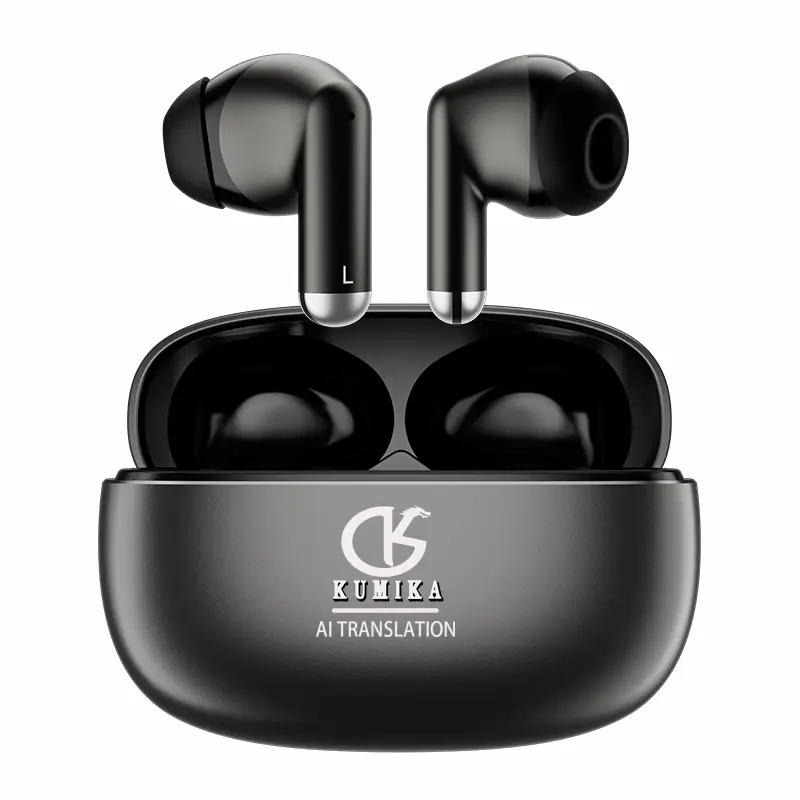
Most AI translation earbuds wholesale quotes open with a language count. It is the least useful number in the document, and it is the one every buyer checks first.
What is inside the earbud, and what is not
Open a 12 USD translation earbud and a 40 USD one and the difference is rarely the speaker. It is the chip and the firmware behind it.
The J02 we ship runs a Bluetrum SoC on Bluetooth 5.0. Bluetrum’s own reference designs make the split visible: their BT892X series carries the translation feature on devices like Timekettle’s, quoting 40 online languages, beamforming noise reduction and 30 dB of ANC — from a chip that holds no language model at all. Their newer BT895X adds a NPU and a link to Volcano Engine’s model platform, and still routes the actual translation through a server.
So when a factory quotes you a chipset, they are telling you which half of the product you are buying. A plain audio SoC means the phone does all the work: the earbud is a microphone and a speaker with good timing. An SoC with an NPU means some wake-word and noise work happens on the device, which shortens the chain by a few hundred milliseconds but does not remove it.
Neither is a defect. The defect is quoting a language count without telling the buyer which one they are getting.
Three modes, and only one of them is hard
Suppliers quote a language count. Almost none quote a mode. The mode shapes the hardware more than the language count does, and it is the fastest way to tell whether a quote is realistic.
One-way listening
One person speaks, one person hears the translation: a museum tour, a lecture, a factory walkthrough. One microphone, one speaker, one audio path. Technically the easiest of the three and the cheapest to build. If a supplier’s demo is a guide talking into a device while you listen, you have only seen this mode.
Face-to-face conversation
Two people take turns. Now the device has to detect when one speaker stopped and the other started — voice activity detection — and do it in a room with background noise. This is why conversation mode that sounds clean in an office collapses at a trade show booth. Most earbuds dodge the problem by putting one earbud on each person, which removes the turn-taking question and replaces it with a pairing question.
Our J02 real-time translation earbuds are built for this mode: 4 to 8 hours per charge, dual-channel stereo, 10 m range, 50 units minimum. The number worth asking about is not the language count but how many seconds pass between the end of a sentence and the start of the translation, measured in a noisy room.
Simultaneous interpretation
The speaker does not stop. The device segments continuous speech, translates each segment, and plays it back while the next sentence is already underway. This cannot run offline. Our back-clip translator quotes 134 languages for simultaneous interpretation, 150 for standard online translation and 76 for photo translation — three numbers that all assume a live connection, because the segmenting happens on the server.
If a supplier offers simultaneous interpretation with no data plan and no Wi-Fi, one of two things is true: they mean consecutive translation with a shorter pause, or the number was copied from a brochure.
| Mode | What it needs | Delay / offline |
|---|---|---|
| One-way listening | 1 mic, playback | 1.5–3 s · offline pack only |
| Face-to-face | 2 mics, voice detection | 2–4 s · offline pairs only |
| Simultaneous | Cloud segmentation | 3–5 s · does not work |
Bluetooth 5.4 will not fix the delay
Classic Bluetooth audio adds roughly 150 to 250 ms. LE Audio with LC3 brings that to about 20 to 30 ms. A server round trip adds 800 to 2,000 ms, and the translation model adds more on top.
Do the arithmetic before you pay a premium. Moving from Bluetooth 5.0 to 5.4 removes maybe 200 ms from a chain that already takes 2,000. It matters for lip-sync on video and for music. It does nothing your customer will notice in a conversation.
Where a newer chipset does earn its price is noise handling. Beamforming with two or three microphones is the difference between a usable translation in a restaurant and a stream of wrong words, because the recognizer transcribes what it hears, and what it hears is the room.
Unpacking the language count
“150 languages” usually means 150 source languages piped into a smaller set of target languages, all online. Offline coverage is a separate, much shorter list — typically 8 to 12 major pairs, downloaded as packs, at lower accuracy on anything technical.
Three checks separate a real claim from a printed one:
- Ask for the list, split by online and offline. Not the headline number. A supplier who has the list will send it in ten minutes; one who does not will send the brochure again.
- Test with an accent and a trade term. Read a sentence containing your product category in a regional accent. General conversation survives this. Technical vocabulary usually does not, and that is where your customer will judge the device.
- Test the same sentence three times. If the output changes meaning between runs, you are looking at a model with a low confidence threshold, and it will embarrass someone in a meeting.
Who pays for the translation in year two
The hardware is a one-time invoice. The translation is a recurring cost, and it lands on somebody. Three software stacks exist, and they age very differently.
White-label app with a public API key. Cheapest to start. The factory ships an app that calls a commercial translation API on a key the factory controls. Your cost is zero until the key hits its limit or the factory stops paying, and then every unit you sold becomes a Bluetooth earbud.
Third-party engine, licensed per unit or per minute. Predictable, and the fee is visible. Ask whether the licence is prepaid for the life of the device or renewed annually, and ask what happens to devices already in the field if you stop renewing.
Own app and own backend. Only a handful of factories have this. It costs more upfront and it is the only version where you can change the brand experience, add languages, or fix a bad translation without waiting for someone else.
Two questions settle it faster than any spec discussion: who owns the app store listing, and what happens to a device whose app is removed from the store? If the answer to the second one is “nothing”, you are not buying a product, you are renting one.
Selling into the EU: the audio leaves the country
Speech is personal data under GDPR. A translation app that sends audio to a server outside the EU is a cross-border transfer, and the transfer needs a legal basis, a notice to the user, and standard contractual clauses with the processor. Most consumer translation apps do exactly this and document none of it.
If your channel is European retail, ask the supplier where the audio is processed and whether they will sign a data processing agreement. A factory that answers “the cloud” has not answered.
The EU AI Act adds a lighter but dated obligation. Article 50 applies from 2 August 2026 and requires that people interacting directly with an AI system be told they are doing so, unless it is obvious from the context. For a translation device it is mostly obvious, but the disclosure belongs in the manual and on the app’s first screen, not nowhere. Penalties run to 15 million EUR or 3% of worldwide turnover, which is a risk your retail customer will eventually push back down the chain.
What to test in a sample, and where to test it
A showroom demo is a quiet room with a native speaker and a script. None of those conditions survive contact with a customer.
- Noise. Test beside a road or in a café, not in the meeting room. This single change rejects most samples.
- Losing the connection. Turn off data mid-sentence. What the device does next tells you whether offline mode exists or is a line on the box.
- Twenty minutes of continuous use. Chips that are fine cold throttle when warm, and translation is a sustained load. Watch for drifting latency and a hot shell.
- Two people talking at once. Real conversations overlap. Devices that assume strict turn-taking produce garbage here.
- A number, spoken. Prices, quantities, dates. Numbers are where translation errors cost money instead of embarrassment.
Matching the form factor to the channel
The category is not one product. Six shapes ship today, and buyers sourcing AI translation earbuds wholesale usually arrive with a shape already in mind — which is the wrong place to start. What you sell decides the shape, not the other way round.
| Shape | Fits |
|---|---|
| In-ear earbuds | Consumer electronics, travel retail |
| Open-ear clip | Sport, tour guiding, long shifts |
| Magnetic phone add-on | Phone accessory channel, low price point |
| Handheld with screen | Business gifting, trade missions |
| Back clip | Conferences, guided tours, B2B |
| Recorder and glasses | Office, education, field inspection |
Two of these are worth naming because buyers keep mis-sorting them. The A30 open-ear translation earbuds use a bone conduction clip design, which is the only shape that survives an eight-hour shift without the ear canal complaining — the trade is that bass and isolation go away. The D1C handheld translator runs its own Android build with a touchscreen, group translation and video calling, so it does not need the customer’s phone at all; that independence is what you are paying for, and it is the difference between selling to a distributor and selling to a company that issues devices to staff.
For the office and meeting channel, the FW920D recorder covers 152 languages with a five-microphone array rated to 10 m and 64 GB of local storage — a different job from a conversation device, since the output is a transcript rather than a reply. The T1 magnetic translator takes the opposite bet: it clips to a phone and keeps the bill of materials low, which is where volume lives. And a translation pair of smart glasses with a 13 MP camera solves a problem earbuds cannot, because the camera points where the wearer looks.
Certification and freight paperwork
Translation adds nothing to the hardware certification list. The device is still a Bluetooth product with a lithium cell, so the file is CE and RoHS for Europe, FCC for the United States, and a UN 38.3 test summary plus an MSDS for air freight. What changes is the software: an app that collects voice and location data now falls under app store privacy rules and, in Europe, under GDPR.
Ask for the certificate with the model number on it. A CE certificate for a different SKU, or a test report with no model field, is the most common paperwork problem in this category — and the one that stops a container at customs.
MOQ, payment and lead time
Here are the terms an AI translation earbuds wholesale order runs on in our own line, so you can calibrate other quotes against them: 50 units minimum for the J02, samples available, 20 to 25 days after deposit, 30 to 35 days when tooling is involved. Payment is 100% T/T below 3,000 USD, moving to 30/50/20 from 200 pieces. Incoterms run EXW to DDP, and batteries ship under the air-freight rules above. The arithmetic behind those three numbers, and which of them is credited back, is on MOQ, tooling and sampling.
A quote far below these numbers usually means one of three things: the translation is a white-label app the factory does not control, the microphone is a single element with no beamforming, or the certificate belongs to another model.
FAQ
Do AI translation earbuds work without internet?
Partly. Offline packs cover a short list of major language pairs, typically 8 to 12, at lower accuracy. Simultaneous interpretation does not work offline at all, because the segmentation runs on a server.
How many languages should I expect for the price?
Online coverage of 100 to 150 languages is normal at consumer price points, because the language list comes from the translation API, not from the hardware. Offline coverage is the number that costs money to add.
Can I put my brand on the app as well as the hardware?
Sometimes. White-label apps usually allow a logo and colours but not a new translation engine. If the app is the factory’s own, ask whether they will ship it under your developer account — that is the only version where you control the store listing.
Are translation earbuds accurate enough for business use?
For negotiation and travel, yes, with the caveat that numbers and contract terms should be confirmed in writing. For legal or medical conversations, no. The device is a convenience tool and no supplier should describe it otherwise.
What is the difference between translation earbuds and a handheld translator?
Independence. Earbuds need a phone and an app; a handheld with its own Android build does not. Handhelds also tend to carry photo translation and a screen you can show to the other person, which matters in a face-to-face sale.
How do I compare two quotes that look identical?
Ask for the chipset model, the offline language list, the name of the translation engine, and a 20-minute noise test. Four questions, and the two quotes stop looking identical.
Tell us what you are building. Send the spec, the market and the volume. A sourcing engineer reads every message, and the quote comes back with the certification list attached.