AI Robot Toy After-Sales: What Fails, What It Costs, and Who Pays
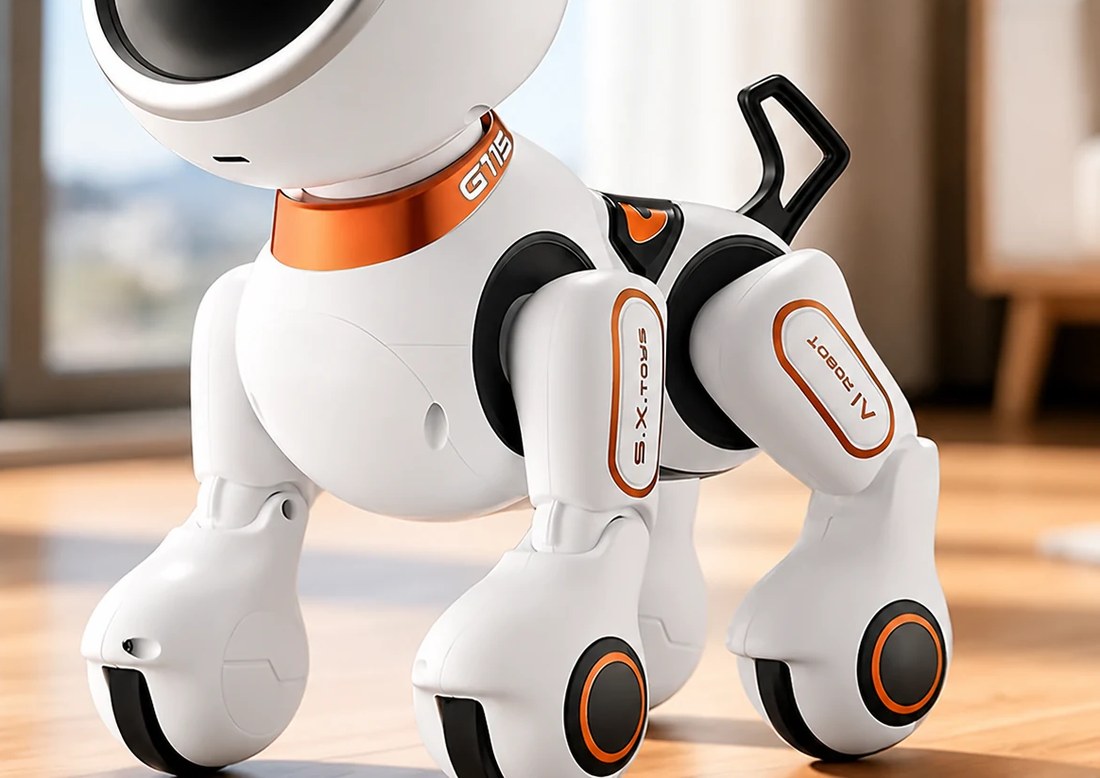
A thousand robot dogs leave Shenzhen in one container. By month four, somewhere between thirty and sixty of them have stopped working, and they are sitting in the importer’s warehouse waiting for someone to decide what to do with them.
The quote sheet that got them there had a line for the unit, the carton, the freight, the certification and the payment terms. It had no line for the second life of the product. That missing line is where the margin on a twenty-dollar toy actually disappears, and it usually happens eighteen months after the order, not during the negotiation.
This is the robot toy after-sales problem in full: what fails, what it costs to fix, and which clauses decide who pays.
What comes back, and why
Four failures account for most of the returns on a walking robot toy. Three of them have a spare part. The fourth does not, and it is the one that ends brands.
The hip and knee joints
Every step loads the hip and knee. Both joints also take a second load that a cycle count never captures: a child pushing the leg backwards while the motor is still holding position. The motor resists, the gearbox does not. Teeth strip.
This is why a robot that survived a 5,000-cycle bench test can fail in a living room in a week. The bench moves the leg. The child fights it. Ask any supplier how the joints behave under reverse torque, and listen for whether the answer describes a mechanical clutch, a current limit in the driver, or nothing at all. The first two are design. The third is a warranty claim waiting for a date.
The battery
A 3.7 V pack of 800 to 1,000 mAh gives forty to sixty minutes of walking and takes two to three hours to charge. Cells swell for reasons that all live outside the factory: months in a hot warehouse at zero charge, an overnight charge on an adapter with no cutoff, a pack run flat and left flat until it will not recover.
A swollen pack announces itself quietly. The case stops sitting flat. Runtime drops by half. The toy still works, which is the problem, because the customer keeps using it for another three weeks.
The charging port
A USB-C receptacle soldered to a board inside a 1.6 kg toy that moves while plugged in. The cable gets pulled sideways, the joint lifts, the port goes intermittent, and the customer reports it as “will not charge” rather than “the port is loose”. On a repair bench it is a fifteen-minute job with a hot air station and a sub-board that costs under a dollar. In a returns process it is a full unit replacement.
The app and the cloud
The fourth failure has no spare part. Voice question-and-answer on these toys runs through the vendor’s cloud, and the toy is a microphone, a speaker and a Wi-Fi or 4G module. If the vendor’s account with the speech or model provider lapses, if the backend is retired with the product line, or if the app is pulled from the store, the toy does not degrade. It becomes a plastic dog that walks.
Buyers audit the battery and the servo and never audit this, even though it is the only component whose failure cannot be repaired at any price.
The return that cannot be shipped
The instinct is to send the broken units back and let the factory deal with them. Run the numbers before you put that in a contract.
A robot dog ships at 1.6 kg in a 22 × 14 × 23 cm box. Express air from the EU to Shenzhen for that parcel runs roughly EUR 45 to 70, and takes five to eight days each way. The unit is worth about USD 22 at 1,000 pieces. The return freight is two to three times the value of the goods, before anyone opens the box.
Then the battery makes it worse. Under IATA Dangerous Goods Regulations, lithium cells identified as damaged or defective are forbidden from air transport (Special Provision A154), and cells shipped for disposal or recycling are forbidden too (A183). A robot whose pack has swollen is not an air cargo item. It is a sea freight item with dangerous goods paperwork attached, and it arrives five to seven weeks later, if the forwarder accepts it at all.
So “send it back and we will repair it” is a sentence that only works until someone reads a freight invoice. It is also why factories quote a low unit price and a vague warranty: the two are connected, and the second one is where they recover the first.
The model that survives contact with a customer
Every importer who has done this for a few years converges on the same answer: ship the parts, not the product. A spare parts ratio of two to three percent, priced into the purchase order at cost, plus a repair path the customer can reach without a courier.
What goes in a kit is decided by failure mode, not by what is easy to pack.
| Part in the kit | What it fixes |
|---|---|
| Two servos, metal gear, hip and knee | The most common mechanical failure, and the one that strands a unit completely |
| One battery pack | Swelling and runtime collapse, which are storage failures rather than defects |
| One charging sub-board | Loose USB-C receptacle, the cheapest fix in the box and the most commonly replaced part |
| Fasteners and the driver bit | Shell screws are usually a tri-wing or pentagon head, and no household owns one |
| One leg assembly | Cracks at the joint housing after a fall, which is not covered but is the repair customers ask for |
A kit built this way costs roughly USD 4 to 6.50 at factory cost. At a three percent ratio that is about USD 0.15 per unit on a USD 22 toy, well under one percent of the goods value, and it converts a refund into a repair.
Where the repair actually happens
Not at a toy shop. Toy retailers do not own hot air stations, and they will not open a product they cannot buy parts for. The place that can fix this is the phone and tablet repair shop on the same high street, which already has the tools, the drivers and the staff used to working at this scale.
What they need from you is four things: an exploded parts diagram, the torque spec for the joint screws, part numbers that can be reordered, and a short video per replacement. Three minutes on a phone camera, filmed at the factory, saves a phone call per unit for the next three years. Print a QR code to it inside the box and the customer can hand the phone to the technician.
Two consequences follow. Repairs become a paid service with a margin attached instead of a cost centre. And the customer keeps the product, which is worth more than the refund you did not have to pay.
Ten lines for the purchase order
A warranty paragraph that says “twelve months against manufacturing defects” settles nothing. These are the lines that decide outcomes, in the order they get argued about.
| Clause | What it should say |
|---|---|
| Dead on arrival | Thirty days from receipt. Replacement, not repair. Seller pays outbound freight, buyer scraps locally and sends video evidence. |
| Cover period | Twelve months from invoice, with exclusions listed explicitly: water, drop, wrong charger, opened shell. |
| Claim evidence | Serial number plus a fifteen-second video showing the fault. This single requirement removes most of the arguments. |
| Response time | Five working days to accept or reject a claim, in writing. Silence counts as acceptance. |
| Settlement | Credit note against the next order, or parts at no charge. Buyer chooses, because the buyer knows which is useful. |
| Spare ratio | Three percent free with the order, priced parts available for three years after end of production. |
| Minimum claim | No minimum. A batch threshold is how small importers get their claims refused. |
| Software support | A stated support period for the app and the cloud service, in months, with notice before shutdown. |
| Recall cooperation | Notification within forty-eight hours of a safety issue, and cost sharing stated in advance rather than negotiated during a crisis. |
| Tooling and files | Who owns the mould, and whether the firmware source or a build can be escrowed. |
Most suppliers will sign eight of these ten without much resistance. The two that get pushed back on are software support and recall cost sharing, and those are exactly the two that turn into a lawsuit rather than a credit note.
The deadline that changes the contract: 9 December 2026
For importers selling into the EU, the after-sales question stopped being commercial and became legal.
Directive (EU) 2024/2853, the revised Product Liability Directive, must be transposed by member states by 9 December 2026 and applies to products placed on the market from that date. Three changes matter for a connected toy.
Software and AI systems are products. An app, an operating system and a model are inside the scope, so a defect that appears through an update or a cloud behaviour is a product defect, not a service hiccup.
Liability cannot be contracted away from an injured person. Between businesses a contract still allocates cost, but it does not shield anyone from a consumer claim.
Failing to supply a security update that was within the manufacturer’s control can defeat the defence that the defect did not exist at the time of sale. The manufacturer’s control explicitly covers software it is in a position to provide, or to have provided by a third party.
Add the liability of the EU-based importer and authorised representative when the maker sits outside the union, and the practical result is simple: the support period you promise is now a liability figure, and it has to be written into the supply contract before the product ships, not negotiated after the first failure.
The Cyber Resilience Act adds the reporting side. Vulnerability reporting obligations for products with digital elements have applied since September 2026, with the full security requirements following in December 2027. A supplier who cannot name a support period, a patch path and a component list is a supplier who has not read either instrument.
A worked example at 1,000 units
Assume a USD 22 unit, a EUR 79 retail price, and three percent claims, the low end of the range above. Thirty units come back. Three ways to settle them.
| Settlement model | Cost of thirty claims |
|---|---|
| Credit note only | About USD 660 refunded, and thirty customers who now have no product |
| Full replacement by air | About USD 930 including freight, plus thirty units of scrap with batteries to dispose of |
| Three percent spare kit | About USD 150 in parts, plus local labour the customer pays for |
The kit model is the cheapest by a wide margin, and it is also the only one that leaves the customer holding a working product. The saving is real but it is not the point. The point is that a refund ends the relationship and a repair extends it, and the second one is what a distributor needs in month fourteen when the reorder is being discussed.
Where the kit model fails is when the fault needs a part that is not in the box. That is why the ratio is set by failure data rather than by habit, and why the clause on three-year parts availability matters more than the discount you negotiated.
Frequently asked questions
What defect rate should I plan for?
Plan on one to three percent dead on arrival and another two to four percent failing within twelve months on a walking robot. Treat those as planning numbers, not promises, and ask any supplier for their own field data. A supplier who can produce a claim log by part is telling you something a supplier who quotes a percentage cannot.
Who should pay return freight?
Nobody, in most cases. The freight exceeds the value of the goods, and a swollen battery cannot fly. Pay for parts and local labour instead, and write that into the clause so it is a process rather than a favour.
Does local repair void the warranty?
Only if you write it that way. Authorise named repair partners, require photos before and after, and keep the warranty on the parts you supplied. A customer who repairs is a customer who stays.
What happens when the app is retired?
That depends entirely on what was signed. Ask for a support period in months, a notice period before shutdown, and whether the firmware can be escrowed. If the answer is that the app will always be available, get it in writing with a date attached.
Is a cheaper unit with a shorter warranty actually cheaper?
Two dollars on a thousand units is two thousand. Thirty replacements cost about nine hundred and thirty. On paper the cheaper unit still wins, so this is not an arithmetic argument. The paper does not price the thirty one-star reviews, the warehouse labour, or the fact that the distributor who spent a quarter handling someone else’s defects does not send the next order. That is a judgement, not a calculation, and it is the one that gets made.
Where this fits
The sourcing side of a robot toy is decided at the sample stage: servo count, gear material, drop height, battery documentation. That work is covered in our AI robot dog wholesale guide, and the camera-and-motion category is covered in the AI robot camera supplier guide.
After-sales is decided at the contract stage, and it is the part buyers skip because it feels like paperwork until it is a warehouse full of dead units. If you only take one thing from this, make it the spare kit: a robot toy after-sales plan that depends on return freight is not a plan, because the freight costs more than the toy.
If you are specifying a robot toy now, the two products where these failure modes are easiest to see in the open are the G115A-SX robot dog, a 1.6 kg walking unit with eight to twelve servos, and the FW950A companion robot camera, which adds a drive base and a charging dock to the same problem. Ask us for the spare parts list and the joint torque spec before you ask for the price. We would rather send both.
Tell us what you are building. Send the spec, the market and the volume. A sourcing engineer reads every message, and the quote comes back with the certification list attached.