AI Robot Dog Wholesale: A 2026 Buyer’s Guide
An AI robot dog returns to you for two reasons: a stripped servo gear, or a cracked leg after one fall from an 85 cm table. Both are decided at the sample stage, not the inspection stage. Ask for the servo count, the gear material, and the drop height on the test report before you discuss price per unit.
What an AI robot dog is made of
Strip the shell and four subsystems decide the unit cost. The plastic costs least of the four, yet it absorbs most of the quality complaints.
The servos
A walking toy dog uses 8 to 12 servos. Plastic gears survive roughly 5,000 to 8,000 movement cycles. Metal gears reach 20,000 cycles and cost 0.6 to 1.2 USD more per servo, which puts 5 to 12 USD on the unit.
Ask which joints carry metal. The hip and knee joints take the load on every step. The tail and ear joints almost never fail, so paying for metal there is waste.
The battery and the runtime
A 3.7 V lithium pack of 800 to 1,000 mAh gives 40 to 60 minutes of continuous walking. Charging takes 2 to 3 hours through USB-C. The retail box must state the runtime honestly, because a child measures it in one afternoon.
Lithium cells also change the shipping class. Air freight needs a UN 38.3 test summary and the battery mark on the carton. A toy that ships by sea to save cost arrives two weeks later than the buyer planned.
The shell and the joints
ABS with a 2 mm wall thickness survives a fall from 85 cm onto tile. Thinner walls crack at the leg socket, which is the failure you see in one-star reviews. Ask for the wall thickness in millimetres, not for the word “strong”.
The voice module
Most units run a wake word on device and send the actual question to a cloud engine. That split matters. On-device wake keeps the toy responsive when the Wi-Fi drops. Cloud answers give you a wider vocabulary but a 1 to 2 second delay.
| Build | Servos | Gears | Runtime | FOB range |
|---|---|---|---|---|
| Entry | 8 | Plastic | 40 minutes | 12 to 18 USD |
| Mid | 10 | Metal hips, plastic elsewhere | 50 minutes | 19 to 26 USD |
| Premium | 12 | Metal hips and knees | 60 minutes | 27 to 35 USD |
Those ranges move with the order volume and the packaging. Use them to spot an outlier quote, not as a target to argue down.
Which age band changes the design
A toy sold for ages 3 to 5 needs no small parts that fit a cylinder the size of a child’s throat. That rule removes detachable ears, a clip-on tail, and any button under 6 mm across.
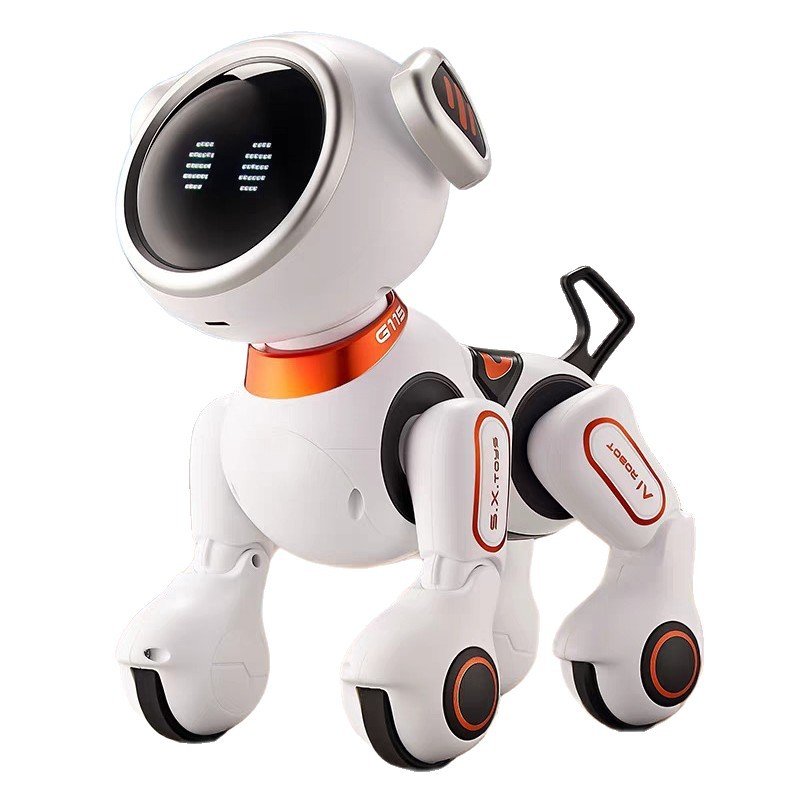
The G115A-SX robot dog is built for ages 4 to 6, which is the band where a walking toy with a voice still sells. Push the same hardware to ages 3 and up, and the tail and ear geometry has to change, which means a new mould.
Above age 6, buyers tolerate a larger battery and a louder speaker. Below age 3, most markets will not accept a motorised toy at all, because the small-parts rule collides with every joint.
The documents that decide customs
Toy safety is the tightest paperwork in this category. Three files matter.
The EU Toy Safety Directive 2009/48/EC sets the essential requirements, and EN 71 splits the testing into mechanical, flammability, and migration of elements. A CE mark without an EN 71-1 report naming the model is a customs risk, not a certificate.
In the United States, ASTM F963 is the mandatory toy standard, enforced by the CPSC. A children’s toy also falls under CPSIA, which requires a Children’s Product Certificate and third-party testing at an accredited lab.
Radio adds a second layer. A toy with Wi-Fi or Bluetooth needs an FCC authorization in the US and a RED test report in the EU. That report must name the assembled toy, not the Wi-Fi module, or the two documents will not match at the border.
How to test a sample in six steps
- Walk the dog on tile for 20 minutes and listen for a gear grind at the hip joint.
- Drop it from 85 cm onto a hard floor, on a corner, three times.
- Disconnect the router and check whether the wake word still responds.
- Run the battery flat, recharge, and confirm the runtime claim still holds.
- Hand it to a child in the target age band and watch what breaks first.
- Unscrew the battery cover and check whether a coin can open it.
Step 6 fails more samples than any other. A battery compartment that opens with a coin is a recall risk in the EU, and it is the first thing an auditor checks.
Robots fail in the field in ways the sample room never shows. If you are setting a spare parts budget for a walking toy, our guide to what actually comes back in the first year covers the failure modes, the freight maths, and the clauses that decide who pays.
Where buyers get this wrong
The first mistake is comparing quotes on the retail box photo. Two dogs that look identical can differ by four servos, and the retail price cannot hide that gap.
The second is ordering one colourway across every model. A walking toy sells on the demo, and the demo colour is usually the one that photographs well, which is rarely the one that costs least to mould.
The third is treating the voice feature as software. It is a cloud account, a content filter, and a privacy notice. A toy that records a child’s voice without a stated retention policy is a problem for the retailer, not the supplier.
Frequently asked questions
How many servos should a wholesale AI robot dog have?
Eight is the floor for a walking gait. Ten to twelve gives smoother motion and a longer life at the hip joints, and adds 4 to 9 USD to the unit cost.
What is a realistic MOQ?
Stock colourways usually start at 300 units. A new shell colour or a printed logo moves the floor to 1,000 units, because the mould setup is charged per run. The full ladder — what each change does to the minimum, the calendar and the tooling — is on the MOQ, tooling and sampling page.
How long does production take?
Stock models ship 15 to 20 days after deposit. A new mould adds 25 to 35 days, and a custom voice pack adds about 7 days on top.
Which certifications are mandatory for a toy robot dog?
EN 71 parts 1 to 3 plus the CE mark for the EU, ASTM F963 and a Children’s Product Certificate for the US, and UN 38.3 for air freight. Radio adds FCC or RED.
Can the voice assistant speak another language?
Yes, usually by swapping the cloud engine and the wake-word model. Ask who hosts the engine and whether the licence is per unit or per model, because that is where the hidden cost sits.
What failure rate should I accept on arrival?
Under 2% dead on arrival at 300 units is realistic. Above 5% in a sample of 20 points to a servo or battery problem, not shipping damage.
Next step
Send the age band, the target retail price, the country of sale, and whether the toy needs a voice feature. TuoyangAI is the trading name of Shenzhen Longgang District Tuoyang International Trade Firm, a sourcing partner in Shenzhen working with the factories that build these units rather than owning one.
A short brief gets you a costed comparison across two builds, including packaging and freight. Start with the robot dog product page for specifications, or go straight to the contact page if you already have a target price. Buyers building a wider range usually pair this with our AI children’s plush toys, the AI interactive plush toy, and the AI robot camera line. If the range is toy-led, our AI plush toy sourcing notes cover the soft-goods side.
Tell us what you are building. Send the spec, the market and the volume. A sourcing engineer reads every message, and the quote comes back with the certification list attached.