
AI Toys vs Traditional Toys: Which Is Better for Child Development?
Introduction
If you’ve walked through a toy store recently, you’ve probably noticed something interesting.
On one shelf, you’ll find timeless classics—wooden blocks, puzzles, dolls, and construction sets that have entertained children for generations. On another shelf, you’ll see talking robots, AI-powered learning companions, and interactive toys capable of holding conversations with children.
This raises an important question that many parents are asking today:
Are AI toys actually better for child development, or are traditional toys still the superior choice?
After working with educational products and observing trends in children’s learning technologies, I don’t believe the answer is as simple as choosing one over the other. Both categories offer unique advantages, and understanding those differences is essential for making informed decisions.
Let’s take a closer look.
Understanding Traditional Toys
Traditional toys have been part of childhood for centuries.
These toys typically include:
- Building blocks
- Puzzles
- Toy vehicles
- Dolls
- Board games
- Arts and crafts kits
What makes traditional toys valuable is their simplicity.
A set of wooden blocks doesn’t tell a child what to build. A doll doesn’t dictate how a story should unfold. Children must rely on their imagination, creativity, and problem-solving abilities to create their own experiences.
This open-ended play remains one of the strongest arguments in favor of traditional toys.
What Makes AI Toys Different?
AI toys introduce an entirely new layer of interaction.
Unlike traditional toys, AI-powered toys can:
- Respond to voice commands
- Adapt to a child’s behavior
- Personalize learning experiences
- Provide feedback
- Hold basic conversations
- Track learning progress
An AI educational robot, for example, may recognize a child’s learning level and adjust activities accordingly.
Instead of delivering the same experience every time, AI toys evolve with the user.
This personalization is one reason why AI toys have gained significant popularity in recent years.
Creativity: Which Type of Toy Wins?
One concern often raised by parents is whether AI toys limit creativity.
Traditional toys generally excel in this area.
When children play with blocks, action figures, or art supplies, they create their own worlds without external guidance.
AI toys, on the other hand, sometimes provide more structured experiences.
However, modern AI toys are becoming increasingly creative themselves.
Some AI storytelling toys can generate unique adventures, encourage role-playing, and invite children to contribute ideas throughout the interaction.
Creativity Comparison
| Development Area | Traditional Toys | AI Toys |
|---|---|---|
| Imagination | Excellent | Good |
| Storytelling | Excellent | Good |
| Open-ended Play | Excellent | Moderate |
| Creative Problem Solving | High | High |
For pure imaginative play, traditional toys still maintain an advantage.
Learning and Education
This is where AI toys often stand out.
Educational AI toys can deliver personalized learning experiences that traditional toys simply cannot match.
For example:
- Language-learning robots can practice conversations.
- Coding toys can teach programming concepts.
- Math-focused AI companions can adapt difficulty levels.
- STEM robots can provide instant feedback.
Children receive guidance based on their individual progress rather than following a fixed learning path.
Educational Benefits Comparison
| Feature | Traditional Toys | AI Toys |
|---|---|---|
| Personalized Learning | No | Yes |
| Real-Time Feedback | No | Yes |
| Skill Tracking | No | Yes |
| STEM Education | Limited | Excellent |
| Language Learning | Limited | Excellent |
For educational outcomes, AI toys offer significant advantages.
Social and Emotional Development
Child development is not only about academics.
Social skills, emotional awareness, and communication are equally important.
Traditional toys often encourage face-to-face interaction.
Board games, role-playing toys, and group activities naturally promote communication between children and family members.
AI toys are beginning to contribute in this area as well.
Some companion robots can help children practice conversations, identify emotions, and develop confidence in communication.
However, AI cannot fully replace human relationships.
Children still need meaningful interactions with parents, siblings, friends, and teachers.
In my view, AI toys should support social development rather than become substitutes for it.
Engagement and Long-Term Interest
One challenge many parents face is keeping children interested in toys after the initial excitement fades.
Traditional toys often rely on a child’s imagination to maintain engagement.
AI toys use adaptive technology to create new experiences over time.
A smart learning companion may introduce new challenges, remember previous interactions, and personalize future activities.
Engagement Comparison
| Factor | Traditional Toys | AI Toys |
|---|---|---|
| Initial Excitement | Moderate | High |
| Long-Term Adaptability | Low | High |
| Personalized Interaction | No | Yes |
| Replay Value | Medium | High |
For long-term engagement, AI toys often perform exceptionally well.
Screen Time Considerations
Many parents worry about excessive screen exposure.
Interestingly, not all AI toys rely heavily on screens.
The newest generation of AI toys includes:
- Interactive robots
- Voice-controlled companions
- Smart plush toys
- Educational assistants
These products provide intelligent interaction while reducing dependence on tablets and smartphones.
As a result, parents can enjoy the benefits of technology without increasing screen time significantly.
What Experts Are Seeing in 2026
The most successful educational environments are no longer choosing between traditional toys and AI toys.
They are combining both.
Schools, learning centers, and forward-thinking parents increasingly use hybrid play approaches.
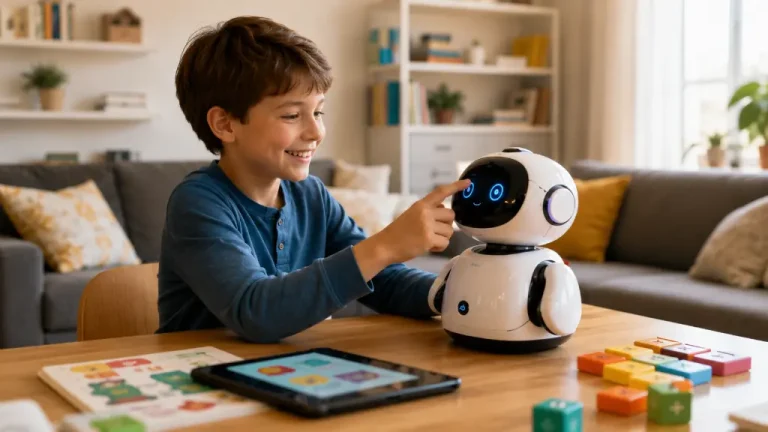
A child may spend one hour building with blocks and another hour interacting with an AI coding robot.
This combination develops creativity, problem-solving, communication, and technological literacy simultaneously.
Rather than competing against each other, traditional toys and AI toys often complement one another remarkably well.
Conclusion: Which Is Better?
If the goal is imagination and open-ended creativity, traditional toys remain incredibly valuable.
If the goal is personalized learning, adaptive education, and interactive engagement, AI toys clearly offer advantages that traditional toys cannot provide.
My professional opinion is that the question should not be “AI toys or traditional toys?”
The better question is:
How can we use both to create the most balanced developmental experience for children?
The future of play is unlikely to be fully traditional or fully digital.
Instead, it will combine the creativity of classic toys with the intelligence of modern technology.
And for today’s children, that combination may offer the best of both worlds.